
Key Takeaways
In this article we’ll explore:
- Current U.S. gold reserves and composition — how much gold the United States holds and where it’s stored
- The Gold Reserve Transparency Act of 2025 — what it proposes and why it matters for public audit and government transparency
- Transparency and accountability concerns — common questions about whether the U.S. still reports accurate gold holdings
- The 1933 gold confiscation legacy — how historic U.S. policy shaped today’s gold ownership rules
- Evolution from the gold standard to fiat currency — what happened and why
- How all of this impacts gold investment decisions
By the end, you’ll have a full picture of U.S. gold reserves, why transparency in gold holdings is a hot topic, and how this ties into broader monetary history.
Current U.S. Gold Reserves — Holdings & Composition
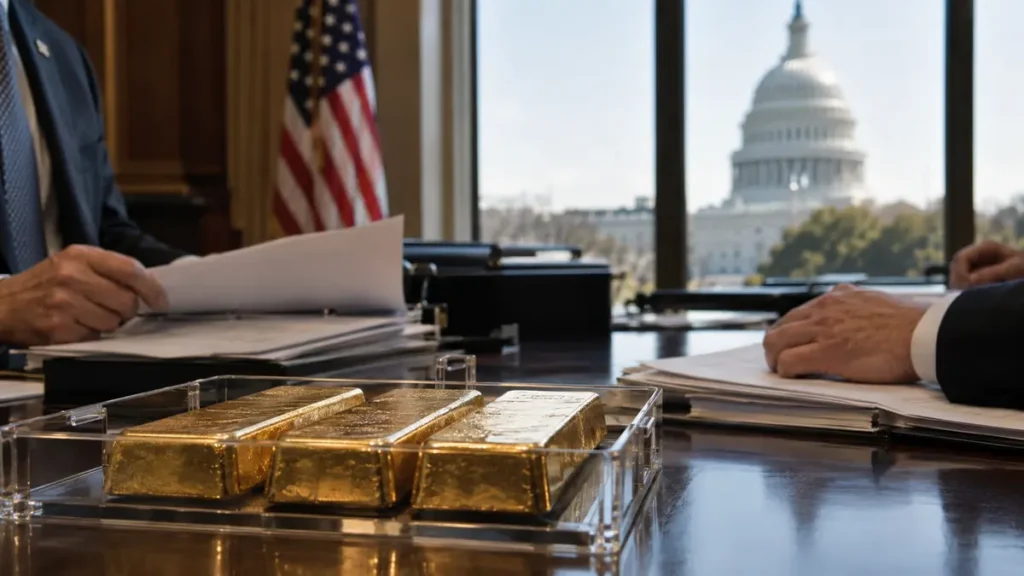
The United States holds one of the largest gold reserves in the world, with the bulk stored in highly secure facilities such as Fort Knox (Kentucky), West Point, Denver, and the Federal Reserve Bank of New York.
- Total U.S. gold reserves are estimated at over 261 million troy ounces, which translates into thousands of metric tons.
- Reserves are held in the form of gold bars of varying purity — some meeting international “Good Delivery” standards and others from older stockpiles.
- The official U.S. book value of gold on government accounts remains artificially low (set by law in 1973 at about $42.22 per ounce), which is far below the metal’s market value.
Why this matters for investors: Understanding the size and composition of U.S. gold holdings helps frame how precious metals figure into national policy and global finance.
What Is the Gold Reserve Transparency Act of 2025?
The Gold Reserve Transparency Act of 2025 is a legislative proposal introduced in both chambers of the U.S. Congress that aims to dramatically increase public visibility into America’s gold reserves.
What the Bill Would Do
- Mandate the first full independent audit of U.S. gold reserves in over six decades, conducted by an outside auditor chosen by the Comptroller General.
- Inventory all gold holdings, including “deep storage” locations, and report on physical security measures.
- Publish a complete accounting of sales, purchases, leases, swaps, and other transactions affecting U.S. gold over the past 50 years, with no redactions except for genuine security concerns.
- Require regular audits every five years to keep data current and accessible.
Why Transparency Is a Hot Topic
Transparency advocates argue that credible auditing increases public trust in how government manages valuable assets, especially since gold plays a symbolic and economic role in markets.
Critics or cautionary voices counter that full openness must be balanced with national security considerations. Though the legislation has been introduced and referred to committee, it has not yet become law.
Transparency in U.S. Gold Reserves — What’s the Debate?
For decades, questions have circulated about how transparent the U.S. government is regarding its actual gold holdings:
- Are the figures accurate? Government reports list official holdings at a book value that doesn’t reflect current market values or recent transactions.
- Is all gold accounted for? Because the last fully comprehensive audit was many decades ago, some analysts and commentators question whether recorded bars match physical holdings.
- What about leases and swaps? The proposed Transparency Act requires disclosure of whether gold has been leased or swapped, a topic that hasn’t been consistently reported publicly.
For many investors, these debates tie into larger issues about monetary policy and confidence in government reporting.
The 1933 Gold Confiscation Legacy
Understanding today’s gold reserve discussions requires a historical detour to the 1930s:
Executive Order 6102
In 1933, President Franklin D. Roosevelt issued Executive Order 6102, which forbade most private ownership of gold coins and bullion and mandated that individuals turn in their gold in exchange for paper money.
Gold Reserve Act of 1934
This act consolidated U.S. gold under Treasury control and changed how gold backed the dollar. It also effectively ended private redemption of currency for gold.
These policies are sometimes referred to collectively as “gold confiscation,” and while private gold ownership was later legalized again in the 1970s, this legacy still influences public perception about government control over gold.
From Gold Standard to Fiat Currency
The U.S. once operated on a gold standard, where paper money could be redeemed for a fixed amount of gold. Over the 20th century, economic pressures and evolving monetary policy pushed the U.S. away from this system:
- The gold standard was progressively weakened through the early and mid‑1900s.
- In 1971, President Richard Nixon ended the dollar’s convertibility to gold for international transactions, effectively transitioning the U.S. to a fiat currency system (where money isn’t backed by a commodity).
- Since then, the U.S. dollar’s value has been based on economic strength and market confidence rather than a fixed amount of gold.
This shift has significant implications for investors, because gold — unlike fiat currencies — retains intrinsic value and can act as a hedge against inflation and currency risk.
What This Means for Investors
Today’s gold transparency discussions and historical legacies matter because they affect how people perceive gold as a safe‑haven asset, a store of value, and a long‑term investment tool.
Many investors ask:
- Should I invest in gold now? Many choose gold to hedge against inflation or diversify portfolios.
- Does transparency impact price? Greater clarity about central bank reserves can influence market sentiment and pricing dynamics.
- What role does U.S. policy play globally? The U.S. dollar’s fiat status and gold holdings influence global finance and monetary confidence.
If you’re considering long‑term precious metals investing or gold‑backed retirement accounts, this broader context is critical to informed decisions.
Conclusion — Gold Reserves, Transparency & Your Wealth Future
The United States holds one of the world’s largest gold reserves, but questions around transparency — highlighted by the Gold Reserve Transparency Act of 2025 — show that public confidence and accountability are still evolving. The legacy of gold policy, from 1933’s restrictions to the fiat currency era, shapes how investors think about gold today.
Whether you’re a seasoned bullion investor or exploring precious metals for the first time, understanding this history and these dynamics can help you build a stronger, more resilient portfolio.
For investors interested in leveraging gold for retirement planning, Opulent Gold Group offers expert Gold IRA services, helping you diversify with physical gold and navigate the complexities of precious metal investment. Learn how a gold‑backed IRA could fit into your financial goals with guidance from seasoned professionals.