
🎧 Listen to the Summary
How to Change Your Gold IRA Custodian: In-Kind Transfer Checklist
Can You Switch Gold IRA Custodians Without Selling Your Metals?
Potentially, yes. If the receiving custodian accepts your existing bullion and both institutions support the required transfer process, an in-kind arrangement may be available.
Your gold may not need to change vaults. That depends on whether the new custodian supports the existing depository and its procedures.
Transfer expenses may apply. These can include account termination, processing, storage-related handling, or insured transportation.
Confirm before moving anything: Obtain written acceptance of the metals, transfer instructions, and applicable charges from the relevant institutions.
What Changes When You Switch Gold IRA Custodians?
Changing your custodian means transferring the administration and custody arrangements of an existing retirement account to another eligible institution.
Your retirement assets do not necessarily need to change. However, the institutions responsible for account records, transaction instructions, asset reporting, and storage coordination may change.
For a physical Gold IRA, this creates several questions that do not arise in the same way when transferring an account containing only cash or publicly traded securities.
Your Account Records
The receiving custodian must establish the appropriate account records and document the assets transferred from the outgoing institution.
The account holder should confirm that the intended IRA type is maintained and that the receiving institution understands whether the transfer is complete or partial.
Your Existing Bullion
Coins and bars already owned by the IRA may remain eligible holdings, provided the proposed transfer meets applicable rules and the new custodian accepts those products.
Acceptance should be confirmed for the actual inventory rather than assumed from a generic statement that the custodian supports gold.
Your Storage Arrangement
The receiving institution may support the current depository or require a different storage provider.
The outcome determines whether the change can be handled primarily through custodial documentation or requires physical movement of the metals.
The central question is not simply whether you can switch custodians. It is whether you can switch while preserving the specific metal holdings and storage conditions you want to maintain.
Four Things to Verify Before Changing Your Gold IRA Custodian
Before submitting transfer paperwork, confirm the following details about your current account and the proposed receiving arrangement.
1. The Exact Metals You Own
Obtain a detailed inventory identifying the metal type, product, quantity, weight, fineness, and any recorded serial numbers or assay information. Include assets with pending transactions or special storage conditions.
2. The Receiving Custodian’s Product Acceptance
Send the inventory to the proposed custodian and request written confirmation of which holdings it accepts, whether any require additional verification, and whether an in-kind transfer is supported.
3. The Depository Arrangements
Confirm whether the assets may remain in the existing vault, whether the new custodian supports that facility, and whether a change of depository will affect storage classification, insurance, or handling costs.
4. The Total Cost of Changing Institutions
Request separate information about outgoing fees, new account charges, vault handling, physical transportation if necessary, and any costs arising from metals that cannot be transferred directly.
If you have not yet determined which institution is appropriate, review our separate guide to evaluating Gold IRA custodians. The purpose of this article is to explain the actual transition once a potential receiving institution has been identified.
How to Change Your Gold IRA Custodian in Six Steps
The sequence below is a practical framework. The exact order and required documentation may differ by custodian, account type, and depository.
Step 1: Request an Inventory and Final Account Information
Contact your current custodian and request the latest account statement together with a metal inventory from the relevant records.
Ask whether any pending trades, outstanding expenses, required cash reserves, or restrictions could delay the proposed transfer. If you intend to move only part of the account, identify which assets are included.
Step 2: Obtain Written Acceptance From the New Custodian
Provide the potential receiving institution with the exact bullion descriptions and relevant depository information.
Ask it to identify accepted and unsupported holdings. Do not submit instructions requiring liquidation until you understand whether the current assets can be retained.
Step 3: Confirm the Metal Transfer and Storage Method
Determine whether the assets can remain at the present depository, require insured transport to another vault, or need a different arrangement.
If some metals cannot be accepted in kind, ask the institutions to explain the available alternatives, their costs, and their implications before approving any transaction.
Step 4: Open the Receiving IRA and Complete Authorization Forms
Complete the new custodian’s application and direct transfer instructions, matching the account information with the outgoing custodian’s records.
Confirm the intended IRA type, participating institutions, transfer scope, and authorized asset movement. Ask which party will initiate communication and which confirmation documents will be provided.
Step 5: Monitor the Authorized Asset Transfer
The outgoing and receiving institutions coordinate the transfer according to their procedures.
Depending on the arrangement, this may involve updating custodial records, transferring cash, arranging depository handling, or shipping physical metal through authorized insured channels. Obtain confirmation when the receiving custodian records the assets.
Step 6: Reconcile Every Holding and Close Out the Old Account
Compare the final outgoing account records with the receiving account’s inventory and cash balance.
Confirm that all intended assets were received or properly accounted for, review the charges assessed, and verify whether the prior account was closed or remains open for any reason.
Important: Do Not Move IRA-Owned Gold Yourself
Do not assume personally collecting or transporting your IRA’s gold is an acceptable way to change custodians. Coordinate any physical transfer with the institutions responsible for the account and the depository, and confirm applicable tax and custody rules before authorizing the movement.
What Happens to Your Existing Gold Coins and Bars?
One of the most important decisions when switching an existing Gold IRA custodian is what happens to the physical metals already held in the account.
Different situations require different operational arrangements. A change of institution does not automatically mean every coin or bar must be sold or physically shipped.
Possible Outcomes for Your Existing Metals
| Situation | Possible Transfer Method | Critical Confirmation |
|---|---|---|
| New custodian accepts metals and current vault | In-kind transfer with compatible depository arrangements | Can custodial records change without physical relocation? |
| New custodian accepts metals but requires another vault | In-kind transfer involving physical movement | Who authorizes shipping, insurance and receiving inspection? |
| Some existing products are not accepted | Potential partial in-kind transfer or alternative arrangement | Which products are unsupported, and what are the available options? |
| Transfer requires converting certain metals to cash | Authorized sale inside the existing IRA followed by eligible cash transfer | What buyback quotation, costs and IRA procedures apply? |
This comparison describes possible operational arrangements, not services guaranteed by a particular custodian.
Why Exact Product Acceptance Matters
A receiving custodian may require information about the type of bullion, its purity, the issuing mint or refiner, and how the product is recorded and stored.
For example, a portfolio might contain several government-issued bullion coins and bars from different refiners. The receiving institution should confirm which specific holdings it accepts rather than approving the inventory based on the overall market value of the gold.
Federal precious metals eligibility requirements and a custodian’s product acceptance policies are related but not identical questions.
For background on the applicable product distinctions, see our separate guide to IRA-eligible gold coins and bars.
What if Your New Custodian Rejects a Product?
If a receiving institution will not accept a specific holding, do not assume you must immediately liquidate the entire portfolio.
Ask whether a partial transfer, another eligible custodian, or an alternative approved arrangement is available. If selling the metal inside the IRA becomes necessary, review the dealer’s actual repurchase quotation and any subsequent purchase costs before making a decision.
Preserving the same physical metals can be important to some investors, but avoiding a sale is not always possible or economical. The outcome depends on the exact assets and agreements involved.

Can Your Gold Stay in the Same Depository After Switching Custodians?
Possibly. Some transfers may be completed while the metal remains physically stored at the same facility.
This depends on whether the receiving custodian supports the depository and whether the relevant institutions can update account and asset records under their procedures.
When the Depository Does Not Change
Confirm whether the original storage arrangement can continue, how the account’s holdings will be identified after transfer, and whether any new administrative or storage terms apply.
The absence of physical shipping does not necessarily mean there are no transfer-related costs. Record processing, account registration changes, or other administrative charges may still apply.
When the Gold Must Move to Another Vault
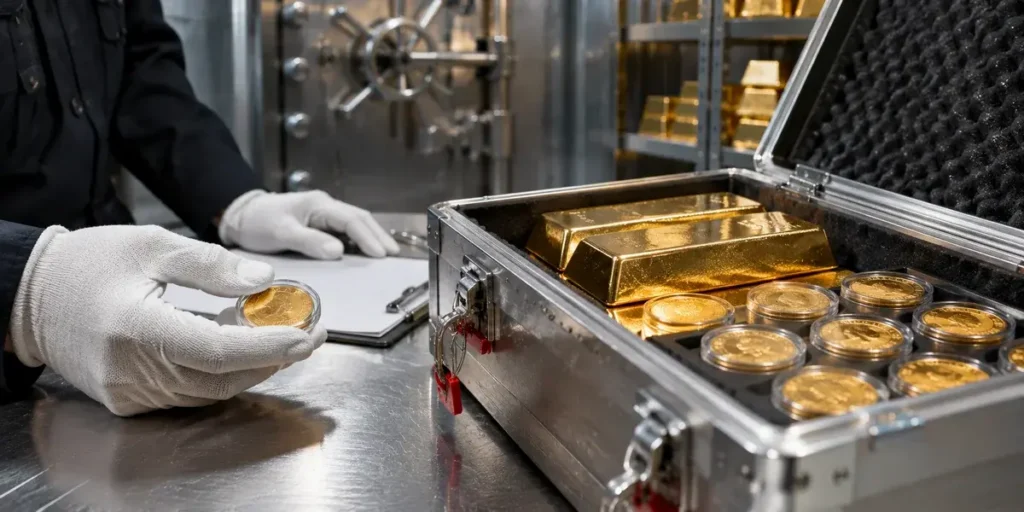
A physical relocation may require controlled release, insured transportation, receiving inspection, and updated inventory documentation.
Before approving the movement, request clarification about:
- Which institution initiates the release and shipment.
- Who is responsible for transportation arrangements.
- What insurance applies during transit.
- How receipt of the metal will be documented.
- How inventory discrepancies will be investigated and resolved.
The new storage agreement should also explain whether the holdings remain individually identified or are subject to a different storage classification.
Practical recommendation: Obtain the receiving institution’s storage instructions before authorizing release from the existing facility.
What Does It Cost to Change a Gold IRA Custodian?
There is no single transfer fee that applies to every Gold IRA. Costs depend on the current account agreement, receiving institution, asset-transfer method, and any changes in the depository arrangement.
When comparing offers, separate one-time transition costs from ongoing account expenses.
| Cost Category | When It May Apply | What to Request |
|---|---|---|
| Outgoing transfer or closing fee | When the existing custodian releases assets or closes an account | Written outgoing fee schedule |
| New custodian setup fee | When establishing the receiving account | Written opening terms and possible waivers |
| Depository handling | When holdings are released, received or re-registered | Handling and verification quotation |
| Shipping and transit insurance | If physical metal must change storage facilities | Insured transport quotation and responsibility |
| Dealer spread and transaction costs | If some metals must be sold or replaced | Current sale quotation and any replacement purchase quotation |
| New recurring expenses | After the receiving account becomes active | Administration, custody, storage and insurance schedule |
Not every charge listed above applies to every transfer. Some may be combined, waived, or handled by a separate institution.
Calculate Whether Switching Will Actually Save Money
If you are changing custodians to reduce annual expenses, compare those savings against the complete transition cost.
Custodian Switching Cost Framework
Total transition cost: Outgoing charges + receiving setup + applicable depository handling + transportation + transaction-related costs.
Potential annual savings: Current recurring expenses − new recurring expenses.
Simple break-even estimate: Total transition cost ÷ annual savings, where annual savings are positive and reasonably predictable.
This framework does not include changes in gold prices or other economic risks. A lower ongoing administration charge alone does not guarantee that switching providers will be financially beneficial.
For company-specific disclosed pricing categories, consult the separate Opulent Gold Group fees and pricing page. The actual terms of the outgoing and receiving institutions must also be obtained independently.
How to Avoid an Unintended IRA Distribution When Switching
The method of transferring an IRA matters because a direct movement between eligible trustees or custodians is not the same as receiving a retirement-account distribution personally.
According to the IRS guidance on trustee-to-trustee transfers, direct transfers between IRAs are not subject to the one-rollover-per-year limitation that applies to certain indirect IRA rollovers.
A properly completed direct IRA transfer generally avoids a personal taxable distribution, provided the transaction preserves the applicable account requirements. Transfers involving conversions, changes in account type, or personal receipt of assets can have different consequences.
For physical gold, the institutions must also determine how the metal remains within an appropriate custodial arrangement.
The detailed distinction between direct transfers, indirect rollovers, and the 60-day rule is explained in our separate Gold IRA transfer vs. rollover guide.
This article concentrates on the transition of existing physical assets. Before authorizing a transfer, confirm the legal and tax treatment of the proposed transaction with the custodians and a qualified tax professional.
How to Verify Your Gold IRA Inventory After the Custodian Change
One of the most useful protections during a custodian change is maintaining a documented comparison of the assets before and after the transfer.
Request the final inventory associated with the outgoing account and compare it with the records issued by the receiving custodian.
What Should Match?
| Inventory Item | Outgoing Records | Receiving Records |
|---|---|---|
| Metal and product description | Identify each coin or bar type | Verify the same intended holdings are recorded |
| Quantity and weight | Record unit counts and weights | Reconcile accepted or transferred units |
| Serial or assay identification | Record available identifiers | Match identifiers where tracked |
| Cash balance | Document cash designated for transfer | Confirm net amount received and explain differences |
| Storage arrangement | Identify current depository and classification | Verify the new arrangement and any approved change |
Not every metal product carries a serial number, and not every storage model records individual identifiers in the same way. Ask the institutions what information their records can reliably establish.
How to Handle a Discrepancy
If the recorded quantity, asset description, cash balance, or storage information does not match the expected transfer, ask both custodians for a written explanation.
Do not treat a market-value change as evidence that a different quantity of gold was transferred. Reconcile physical units and recorded cash separately from fluctuations in the quoted market price.
Where independent verification is necessary, consider whether the custodian or depository can provide supporting inventory documentation.
The SEC investor guidance on self-directed IRA risks emphasizes the importance of reviewing account information and recognizing that custodians generally do not independently assess investment quality or legitimacy.
Gold IRA Custodian Change Checklist: Before, During and After
Use the following checklist when coordinating the transition of an existing physical Gold IRA.
Before the Transfer
- Obtain current account statements and a detailed metal inventory.
- Identify any pending trades, unpaid fees or account restrictions.
- Confirm the receiving custodian accepts the exact holdings.
- Determine whether the current vault can be retained.
- Request written transfer and storage costs.
- Confirm the appropriate account and transfer documentation.
During the Transfer
- Verify account identifiers and authorization forms.
- Identify the institution responsible for coordinating each stage.
- Confirm handling instructions for any metal relocation.
- Obtain shipment and insurance documentation if applicable.
- Avoid taking unauthorized personal possession of IRA assets.
After the Transfer
- Compare metal quantities and product descriptions.
- Match relevant serial and assay identifiers, if available.
- Reconcile the transferred cash balance.
- Confirm storage terms and applicable insurance arrangements.
- Review final outgoing and incoming charges.
- Retain confirmations and verify the prior account’s final status.
Frequently Asked Questions About Switching Gold IRA Custodians
Can I change my Gold IRA custodian without selling my gold?
An in-kind transfer may be possible when the receiving custodian accepts your exact bullion products and both institutions support the necessary custody and transfer procedures. It is not guaranteed for every account.
Will my gold have to move to a new depository?
Not necessarily. Your metals may remain at the same facility if the receiving custodian supports that depository and the required account records can be updated. Otherwise, authorized physical movement may be necessary.
What if the receiving custodian does not accept my existing gold?
Ask which products are unsupported and whether a partial transfer or another acceptable arrangement is available. If a sale inside the current IRA is considered, review the buyback terms and the proposed cash transfer process before authorizing it.
What fees should I check when switching Gold IRA custodians?
Review outgoing transfer charges, account termination fees, receiving setup costs, depository handling, insured transportation when required, and any transaction costs related to metals that cannot transfer in kind.
How do I confirm that all my gold was transferred correctly?
Compare the final outgoing account inventory with the receiving custodian’s records, including product descriptions, quantities, relevant identifiers, cash balances and storage details. Request written explanations for discrepancie.
Final Thoughts: Protect Your Existing Holdings During a Custodian Change
Changing your Gold IRA custodian should begin with an assessment of the assets already held in the account.
The most important decisions concern whether the receiving institution accepts your specific coins and bars, whether those metals can remain at their current depository, and what expenses arise from the transition.
A well-documented process includes written product acceptance, clear transfer instructions, confirmation of the storage arrangement, and reconciliation of the inventory after completion.
Where an in-kind transfer is supported, the investor may be able to retain the existing physical metals rather than selling and repurchasing them. However, transfer options and costs depend on the actual custodians, products and account agreements.
Before moving retirement assets, obtain written information, verify the appropriate procedure and avoid assuming that a promotional claim replaces the receiving institution’s requirements.
Explore Gold IRA Options With Opulent Gold Group
If you already have a Gold IRA and are reviewing your options, explore the precious metals information and available services offered by Opulent Gold Group. Confirm transfer compatibility, custodial procedures and applicable charges with the relevant institutions before taking action.
Opulent Gold Group is a precious metals dealer and should not be assumed to serve as the IRA trustee or custodian. Specific transfer assistance and institutional arrangements require confirmation.
Editorial Note: Prepared November 2026. This guide focuses specifically on changing custodians for an existing Gold IRA containing physical precious metals. IRS and SEC resources are provided for relevant regulatory context. The article does not represent confirmation that any particular custodian will accept certain holdings or provide a specified transfer service.
Financial and Tax Disclaimer: This article is for general educational purposes and is not personalized investment, financial, tax or legal advice. Gold and other precious metals involve market risk, liquidity considerations, transaction costs and possible losses. IRA transfers and distributions may have tax consequences when handled incorrectly. Review written agreements and consult qualified professionals before authorizing a transaction.