

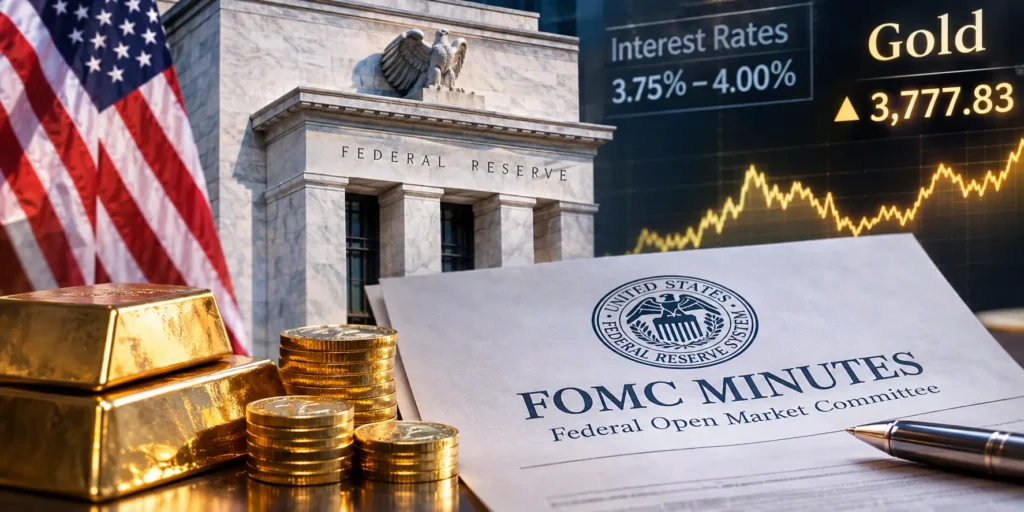
This article examines what the minutes actually revealed, distinguishes the October meeting from economic data published afterward, and assesses the gold market, Treasury yields, and policy outlook using dated, verifiable sources.
October FOMC Minutes: Key Facts
- Meeting: October 27–28, 2026; minutes published November 18 at 2:00 p.m. EST.
- Rate decision: Hold at 3.75%–4.00%; the vote was 10–2.
- October debate: Most participants supported waiting for further information; some favored an immediate 25-basis-point increase.
- Policy outlook: Almost all participants anticipated further rate increases under their baseline scenarios.
- Possible larger move: A couple of participants said an increase of more than 25 basis points at the next meeting might warrant consideration if inflation data were unfavorable.
- Gold after publication: $3,726.19/oz at 2:30 p.m. ET on November 18, down 3.2% on the session, according to Reuters.
Source and timing note: The minutes describe information available at the October meeting. The November 10 CPI release and November 18 market prices occurred afterward and are discussed as separate developments. Reviewed November 21, 2026.
What Happened at the October 27–28 Federal Reserve Meeting?
At its October meeting, the Federal Open Market Committee maintained its target range for the federal funds rate at 3.75% to 4.00%. The decision passed by a 10–2 vote. Lisa D. Cook and Beth M. Hammack preferred an immediate 25-basis-point increase.
The Federal Reserve’s October 28 policy statement described a resilient economy, relatively stable employment, and inflation that remained above the Fed’s 2% objective. The announcement communicated the rate decision but did not explain the full range of views discussed behind closed doors.
The published October FOMC minutes provided that additional detail, including why most policymakers preferred a pause and how participants assessed the likelihood of further action.
| Policy Item | Confirmed Outcome |
|---|---|
| Meeting dates | October 27–28, 2026 |
| Federal funds target range | 3.75%–4.00%, unchanged |
| Committee vote | 10 in favor, 2 opposed |
| Dissenting preference | A 25-basis-point increase |
| Publication of minutes | November 18, 2026, 2:00 p.m. EST |
What the Minutes Revealed
The minutes added substantive information beyond the initial rate announcement. They showed a Committee largely aligned on the need to bring inflation down but divided over whether another increase should occur immediately or after further assessment.
Most Supported Holding Rates in October, but Further Increases Were Expected
Most participants supported maintaining the target range at the October meeting. They cited benefits from evaluating additional information, including the effects of September’s rate increase, financing conditions, the resilience of AI-related investment, and geopolitical developments. Some believed a gradual approach would give the economy time to adjust.
At the same time, almost all participants judged that further increases would likely be appropriate under their baseline outlooks to bring inflation toward 2%. A few who agreed to hold in October described the decision as a close call. This is the central distinction in the minutes: a pause at one meeting was not an abandonment of the tightening outlook.
Some Favored an Immediate Hike; Two Considered a Larger Future Move
Some participants favored increasing the rate by 25 basis points in October, judging existing policy insufficiently restrictive. They warned that delaying action could allow inflation to become entrenched and potentially require stronger tightening later.
Looking ahead, a couple of participants indicated that an increase greater than 25 basis points at the next meeting could merit consideration if new inflation figures were unfavorable. That was a conditional view recorded in the minutes, not a Federal Reserve commitment to a half-point increase.
Inflation Risks Included Energy, Tariffs and AI Investment
Most participants expected inflation to remain elevated in the near term before gradually declining as energy-price pressures, tariff effects and strains related to AI infrastructure spending moderated. They also described broad-based price pressures and risks that inflation could prove more persistent than anticipated.
The staff’s discussion identified uncertainty involving energy prices, geopolitical events, investment-related demand and financing. These findings are more specific than the October statement’s shorter acknowledgment that inflation remained high.
Financial Stability Was Also Discussed
The record included discussion of debt and leverage associated with AI infrastructure development and the possibility that sharp asset-price declines could amplify stress through forced selling. Several participants noted that tools other than the policy rate were generally better suited to address financial-stability vulnerabilities directly.
These issues mattered to the broader policy discussion, although the minutes did not identify any specific gold-price target or predict the future price of bullion.
| October 28 Policy Statement | Additional Detail in the Released Minutes |
|---|---|
| Rates held at 3.75%–4.00% | Most supported waiting for more evidence, while almost all anticipated further tightening under their baseline outlooks. |
| Two dissented | Some participants favored a 25-basis-point move in October; a couple raised the conditional possibility of a larger move at the next meeting. |
| Inflation elevated | Discussion identified broad-based pressures and risks from energy, tariffs and AI-related demand. |
| Economic activity remained strong | Participants examined financing conditions, labor-market risks and financial-stability vulnerabilities. |
Inflation and Employment: What Changed After the October Meeting?
The minutes summarize information available at the October 27–28 meeting. Two major November economic reports were released later, so their results must not be presented as facts policymakers had already reviewed during the October discussions.
October CPI Released on November 10
The Bureau of Labor Statistics’ October 2026 CPI report showed headline consumer prices rising 0.4% month over month and core CPI increasing 0.3%. These figures provided investors with additional information about price pressures after the meeting had concluded.
For the complete breakdown and the separate November 10 gold market response, see our October 2026 CPI and gold analysis.
October Jobs Data Released on November 6
The October employment report also came after the Fed meeting. It showed nonfarm payroll growth of 165,000 and an unemployment rate of 4.1%, contributing to the economic context investors considered in November.
Our separate October 2026 jobs report and gold market guide covers that release in detail. The purpose here is to explain the Fed’s actual October discussion and subsequent November market interpretation, rather than repeat either data report.
How Did Gold Prices React After the November 18 FOMC Minutes?
The November 18 trading session was difficult for gold, with dollar strength, Treasury-market movements and expectations of tighter Fed policy weighing on the metal.
In its November 18 report on gold and the released Fed minutes, Reuters recorded spot gold at $3,726.19 per troy ounce at 2:30 p.m. ET, a decline of 3.2% for the session. This quotation was reported 30 minutes after the minutes were made public.
Gold had touched $3,719.55 per ounce earlier in the session, its lowest level since September 2025 according to Reuters. That intraday low should not be described as a price necessarily reached after the release. U.S. gold futures settled at $3,741.90 per ounce, down 3.2%; their settlement observation is separate from the 2:30 p.m. spot quotation.
Gold Market Snapshot — November 18, 2026
| Observation | Reported Value and Timing |
|---|---|
| Minutes publication | 2:00 p.m. EST |
| Spot gold after publication | $3,726.19/oz; down 3.2% for the session at 2:30 p.m. ET |
| Intraday spot gold low | $3,719.55/oz; occurred earlier in the session |
| U.S. gold futures settlement | $3,741.90/oz; down 3.2% at settlement |
Source: Reuters, November 18, 2026. The 3.2% spot move measures the trading-session decline, not the price change solely between 2:00 and 2:30 p.m. ET. Observations are not synchronized.
Did the Minutes Cause the Entire Gold Selloff?
No single source establishes that the entire 3.2% decline was caused by the minutes. Gold was already falling before publication. The released document reinforced concerns that further monetary tightening could be necessary, while broader dollar strength, Treasury yields and other Fed commentary also influenced trading.
Reuters reported that market pricing for a 50-basis-point December increase moved from roughly 5.3% before the minutes to about 7.3% afterward. These were market-implied probabilities at the time, not the Fed’s decision or a guaranteed outcome.
The defensible conclusion is that the post-publication market environment remained unfavorable for gold, not that every dollar of the day’s price movement can be attributed to this single document.
Treasury Yields, the US Dollar and Gold: What the Data Show
Gold does not pay interest. Higher expected policy rates can make interest-bearing assets relatively more appealing, while a stronger U.S. dollar may make dollar-priced gold more costly for buyers using other currencies.
Reuters described rising Treasury yields and a dollar that reached a 19-month high on November 18. These factors formed part of the reported market explanation for pressure on gold.
Real Yields Are Not the Same as Nominal Yields
Investors should distinguish nominal Treasury yields from real, inflation-adjusted yields. A rise in nominal yields does not prove that the real yield increased by the same amount.
The FRED daily 10-year inflation-indexed Treasury yield series (DFII10) recorded 2.89% on November 17 and 2.88% on November 18, 2026. This daily measure was essentially unchanged, edging lower by one basis point.
These observations do not establish the intraday real-yield reaction to the 2:00 p.m. release. Therefore, it would be inaccurate to claim that a verified spike in the daily 10-year real yield explains the entire gold selloff.
Why the Distinction Matters
Nominal yields: Reported market rates before inflation adjustment; Reuters described upward pressure during the session.
Real yields: Inflation-adjusted rates; FRED’s daily ten-year measure was 2.88% on November 18.
Gold: A non-yielding asset influenced by both types of rates, the dollar, market risk, physical demand and other factors.
What Did the Released Minutes Mean for the December Fed Outlook?
The minutes indicated that the case for further tightening remained strong among policymakers at the October meeting. They also showed disagreement about timing and whether waiting for more data was prudent.
In their baseline outlooks, almost all participants anticipated additional increases. A couple noted that an increase above 25 basis points could merit consideration at the December 8–9 meeting if subsequent inflation information proved unfavorable.
That conditional possibility should not be described as a decision to raise rates by 50 basis points. The Committee’s December action remained dependent on subsequent data, economic conditions and the balance of risks.
The November 10 CPI report, released after the October meeting, added evidence relevant to investors’ November expectations. It did not retroactively become part of the October deliberations.

What Should Gold Investors Take Away From the Released Minutes?
The October minutes confirmed that many policymakers saw persistent inflation as a continuing challenge and that further rate increases remained part of their expected policy path. The gold market was under substantial pressure when the details became public.
However, short-term market movements should not be treated as precise forecasts. Interest-rate expectations, the dollar, real yields and risk sentiment can move in different directions, and gold prices are not determined by a single economic release.
Investors evaluating physical precious metals should also consider liquidity, product premiums, dealer spreads, custody arrangements and the possibility of losses. For a wider discussion of long-term purchasing-power considerations, see our gold and inflation protection guide.
For retirement-account considerations, the Opulent Gold Group Gold IRA information page discusses account structures and available options. An FOMC release does not change the need to verify custodian requirements or ownership costs.
Frequently Asked Questions About the October 2026 FOMC Minutes
When were the October 2026 FOMC minutes released?
The Federal Reserve released the minutes of its October 27–28 meeting on November 18, 2026, at 2:00 p.m. Eastern Standard Time.
What did the October FOMC minutes reveal about future rates?
Most participants supported leaving rates unchanged in October, but almost all expected further tightening under their baseline outlooks. A couple indicated that a rise of more than 25 basis points could warrant consideration in December if inflation data were unfavorable.
What happened to gold prices after the minutes were published?
Reuters reported spot gold at $3,726.19 per ounce at 2:30 p.m. ET on November 18, down 3.2% for the trading session. The quotation was after publication, but the full-day decline did not occur entirely afterward.
Did the Fed raise rates in October 2026?
No. The Committee maintained the federal funds target range at 3.75%–4.00% by a 10–2 vote. Two members preferred an increase of 25 basis points.
Did real Treasury yields rise sharply after the minutes?
FRED’s daily 10-year inflation-indexed Treasury yield was 2.88% on November 18, compared with 2.89% on November 17. Those daily readings do not isolate the immediate intraday response to the minutes.
Did the minutes guarantee a December rate increase?
No. The minutes documented policymakers’ October assessments and conditional expectations. The next decision would depend on subsequent economic information and the Committee’s judgment.
Final Thoughts: What the October Minutes Actually Changed
The November 18 release clarified the Federal Reserve’s October debate. Officials left rates unchanged at 3.75%–4.00%, but almost all participants expected additional tightening under their baseline outlooks. The minutes also documented broad inflation concerns and the conditional possibility of a larger move if later data proved unfavorable.
Reuters recorded spot gold at $3,726.19 per ounce half an hour after publication, down 3.2% over the session. That post-release observation reinforces the importance of interest-rate expectations to bullion markets, but it does not prove that the minutes alone caused the full decline.
For a balanced interpretation, investors should consider the actual policy discussion, the timing of subsequent economic data, both nominal and real Treasury yields, and the broader risks and expenses of owning physical precious metals.
Explore Precious Metals With Opulent Gold Group
Economic developments may influence gold prices, but physical precious metals decisions also involve investment objectives, risk, liquidity and ownership costs. Explore available information and ask about the appropriate account and product requirements before making a financial commitment.
Current product terms, account arrangements and fees should be confirmed independently. No investment return is guaranteed.
Editorial Note — Updated November 21, 2026: This article was revised after the Federal Reserve published the October 27–28 FOMC minutes on November 18. Meeting findings are based on the official minutes; later inflation figures are sourced from BLS, daily real-yield observations from FRED, and historical gold quotations from Reuters. Market prices are dated observations, not live quotes.
Financial Disclaimer: This material is for general educational and informational purposes only and does not constitute personalized financial, investment, tax or legal advice. Precious metals can fluctuate in value and involve transaction costs, spreads, custody expenses and potential losses. Market expectations are not official policy decisions or guarantees of future performance.